Last updated October 15, 2026
ADU Cost Breakdown: The Austin Homeowner’s Reference for 2026
The single most misleading number in Austin ADU pricing is cost per square foot. It hides the fixed costs that don’t change whether the unit is 400 square feet or 800, and those fixed costs are where budgets break down. This guide and our Complete Guide to ADU in Austin give you actual 2026 cost ranges by ADU type in Austin, with line-item context so you know what you’re paying for and why. You’ll learn where the money actually goes, what city fees look like, and how to tell a real price from a contractor’s opening number.
Quick Answer
A new detached ADU in Austin typically costs $160,000 to $290,000 for a 500 to 800 square foot unit in 2026, a garage conversion runs $95,000 to $180,000, and an attached addition runs $140,000 to $240,000. Fixed costs, which include permit fees, utility connections, site work, and design, total $25,000 to $45,000 before any framing starts. Those fixed costs are the reason square-foot pricing falls apart on smaller units.
Table of Contents
- The Fixed Costs Every Austin ADU Carries
- Cost by ADU Type: Detached, Garage Conversion, Attached
- Why Cost Per Square Foot Misleads Austin Homeowners
- Austin Water and Austin Energy Connection Fees for ADUs
- What Allowances in a Bid Mean to Your Budget
- Rental ADUs in Austin: Real Numbers on Return
- Prefab and Modular ADU Options in Austin
- Common Mistakes to Avoid
- When to Call a Professional
- Frequently Asked Questions
The Fixed Costs Every Austin ADU Carries
Before a wall goes up on any ADU in Austin, there’s a stack of expenses that have nothing to do with lumber, drywall, or countertops. These fixed costs land between $25,000 and $45,000 on nearly every project in the city, and they’re the main reason two ADUs of different sizes can end up surprisingly close in total price.
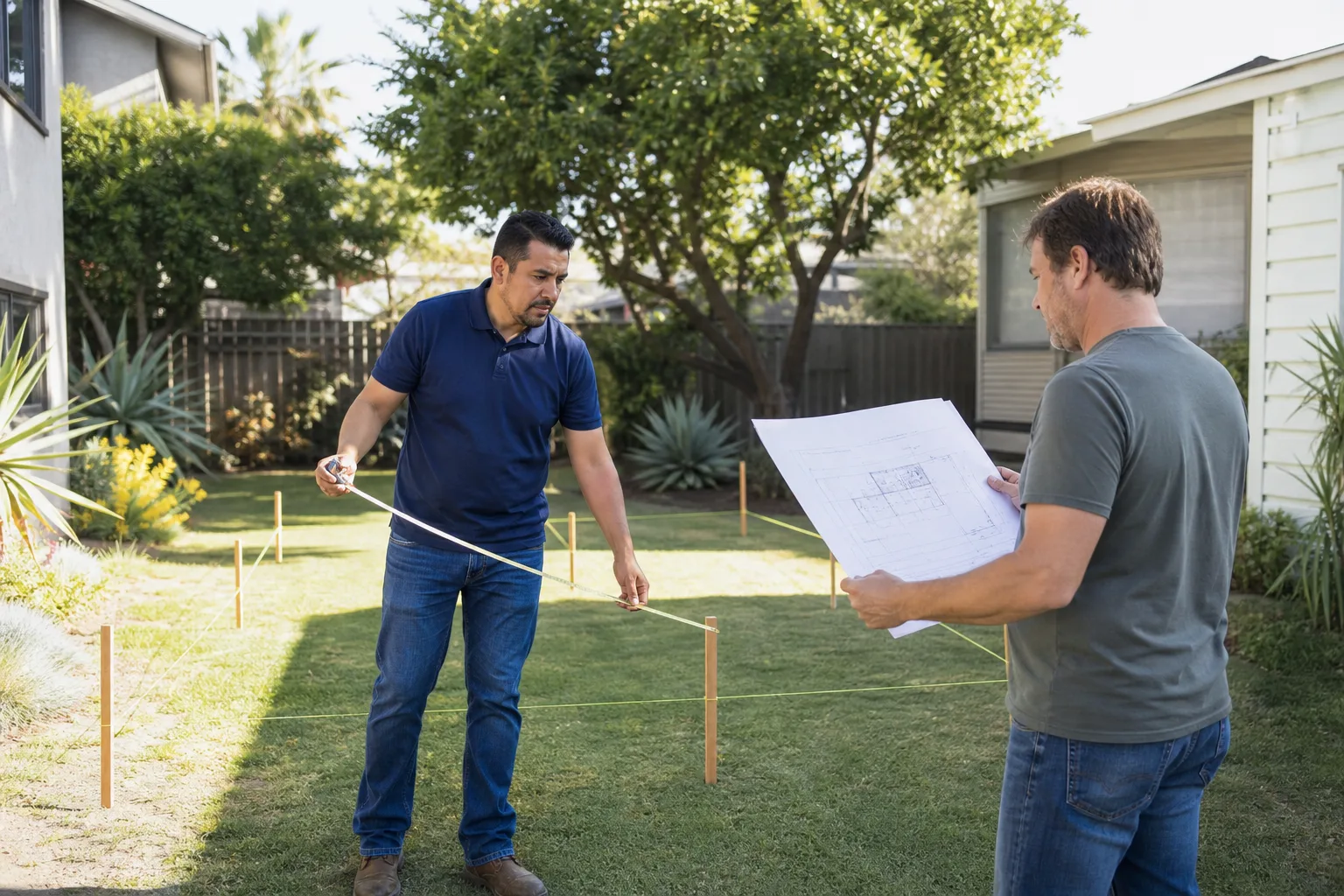
Start with design and engineering. In Austin, a stamped set of plans for a simple detached ADU runs $8,000 to $14,000. That covers architectural drawings, structural engineering, and the site plan the city requires. It does not include survey work, which costs $2,500 to $5,000 depending on your lot. If you’re in a neighborhood with tree protection rules, which includes most of older Austin, an arborist report can add another $800 to $1,500 before you’ve filed anything.
ADU Permits, Codes & Inspections in TX: What You Need to Know explains that permit fees for an ADU in Austin run $5,000 to $9,000 depending on size and scope. The city’s development services department has moved to a valuation-based fee structure, so the permit cost scales with your declared project value. This is not a place to understate numbers to save money. Under-reporting valuation to lower a permit fee can come back as a code compliance problem later, and a lender or buyer will want the paperwork clean.
Site work is the variable everyone forgets. Tree protection zones, existing concrete demolition, and the excavation needed for foundation work add $6,000 to $12,000 on a typical Austin lot. If your yard slopes, and many Austin yards do, add more. The blackland prairie clay under much of the city expands and contracts with moisture, so foundation design matters more here than in Houston or Dallas. A geotechnical report, which tells the engineer what the soil will do under load, costs $1,800 to $3,000 and is worth every cent.
Key takeaway: No matter how small the unit, plan for $25,000 to $45,000 in pre-construction fixed costs. If a bid doesn’t show these line items, they’re hiding in the margins somewhere.
Cost by ADU Type: Detached, Garage Conversion, Attached
Austin’s 2026 subcontractor market has settled into predictable ranges for each ADU type. What pushes a project to the high or low end is usually not size but conditions: site access, existing utility locations, and the finish level you choose.
Detached New Construction
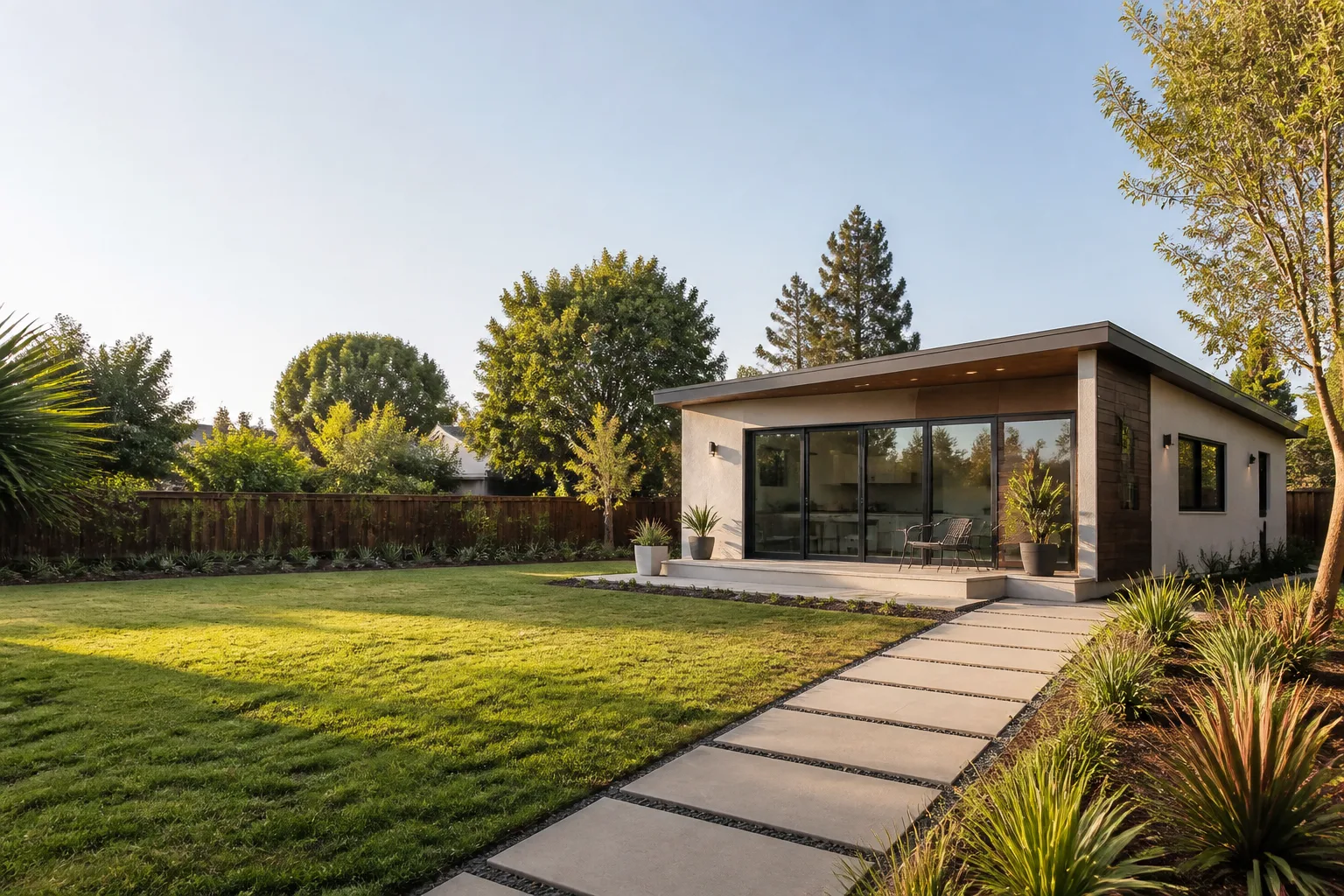
A standalone backyard ADU in Austin runs $160,000 to $290,000 for 500 to 800 square feet with standard finishes. The low end assumes a simple rectangular footprint, a bathroom and kitchenette, and vinyl plank or tile flooring. The high end reflects custom cabinetry, higher-end appliances, upgraded windows, and a more complicated roofline. Detached units carry the full weight of every fixed cost, from a new foundation to a full set of utility runs. They also need their own water and sewer lateral from the street or alley in most cases, which the next section covers in detail.
Garage Conversion
Converting an existing garage runs $95,000 to $180,000 in Austin. The savings come from structure already in place: foundation, framing, roof, and exterior walls are there. What you’re paying for is bringing the space to habitable standard. That means insulation, drywall, electrical panel capacity, HVAC, and possibly raising or replacing the slab depending on ceiling height requirements. Austin requires a minimum ceiling height for habitable rooms, and many older garages fall short, which forces slab work. A garage conversion is also where homeowners run into the city’s parking replacement rules if the conversion removes covered parking. Garage Conversion Contractor in Austin work is a specialty we do regularly because the condition of the existing structure drives the whole budget.
Attached Addition
Building attached to the existing house runs $140,000 to $240,000 for a one-bedroom unit with a separate entrance. The per-square-foot cost lands between the other two types. You share some structure with the main house, which reduces foundation and utility costs, but you also trigger wall removal, tie-in details, and matching exterior finishes. The cost depends heavily on whether the addition shares a wall with a wet area, how far the plumbing rough-in has to travel, and whether the new unit needs its own electrical subpanel. Room Addition Contractor in Austin projects like this are where our written-price-first process matters most, because tie-in work is exactly where contractors bury change orders.
| ADU Type | 2026 Cost Range (Austin) | What Drives the High End |
|---|---|---|
| Detached new build (500-800 SF) | $160,000 – $290,000 | Custom finishes, sloped lot, long utility runs |
| Garage conversion | $95,000 – $180,000 | Slab replacement, structural retrofit, parking rule compliance |
| Attached addition | $140,000 – $240,000 | Roofline tie-in, plumbing distance, matching existing finishes |
Why Cost Per Square Foot Misleads Austin Homeowners
Cost per square foot is useful for comparing two buildings of nearly identical scope. It stops being useful when fixed costs stay constant and only the square footage changes. A 400-square-foot detached ADU and an 800-square-foot one share the same permit fees, the same survey, the same water tap, and nearly the same site work. The only thing that scales is framing, finishes, and mechanical runs.
Take two hypothetical Austin projects. The 400-square-foot unit lands at $175,000, which looks like $438 per square foot. The 800-square-foot unit lands at $260,000, or $325 per square foot. Neither number tells you anything about the other project. The smaller unit is not overpriced. It’s carrying proportionally more fixed cost.
What actually drives price in Austin’s 2025-2026 market is not square footage. It’s five things: access to the build site, soil conditions, distance to utility connections, the finish package, and whether the build method is site-built or factory-built. When you ask a builder for a per-square-foot number, you’re asking the wrong question. The right question is what the fixed costs total and what the variable costs look like line by line. That’s the only way to compare bids accurately.
Austin Water and Austin Energy Connection Fees for ADUs
Austin has published fee schedules for ADU utility connections, and the numbers are higher than most homeowners expect. These are not estimates. They’re the actual charges the city’s utilities apply, and you can verify them against your address by calling Austin Water and Austin Energy directly. Understanding the fee structure before you commit to a design can shape the whole project.
Austin Water charges a tap fee for any new water service connection and a separate tap fee for wastewater. If your ADU connects to the main house’s existing meter, you may avoid a new water tap but still face impact fees. If the ADU needs its own meter, which Austin Water requires for some detached units and which makes rental metering cleaner, the full tap and meter fees apply. For a detached ADU on a typical Austin lot, water and wastewater connection costs run $6,000 to $14,000 combined, and that number can climb on lots where the line has to cross a driveway or run a long distance from the street.
Austin Energy’s fees depend on whether the ADU shares the main panel or gets its own service drop. A subpanel fed from the existing service is the lower-cost path when the main panel has capacity. A new service drop with its own meter runs higher, particularly if the transformer serving your street is already near capacity. In some Austin neighborhoods built out decades ago, secondary infrastructure upgrades can add cost the utility passes through to the customer. The way to find out what applies to your specific address is to request a service planning review from Austin Energy, which gives you the actual charge for your site instead of a range.
Step-by-step: how to get your real utility numbers
- Confirm your ADU type and whether it will have its own meter or share the main service.
- Call Austin Water’s development services line with your address and ask for a tap fee quote.
- Request an Austin Energy service planning review for your address. Ask specifically about transformer capacity and any secondary upgrades.
- Add the two utility numbers to your fixed-cost stack before you sign a design contract.
None of this shows up in a typical per-square-foot estimate. It shows up in a line-item bid, which is the only kind we write.
What Allowances in a Bid Mean to Your Budget
An allowance is a placeholder. The contractor assigns a number, say $12,000 for finishes or $4,000 for plumbing fixtures, and the real cost gets reconciled later. If the actual cost comes in higher, you pay the difference. If it comes in lower, you may or may not see a credit depending on the contract language. A bid with allowances is not a price. It’s a guess with your signature on it.
Here is what that looks like in practice. A $150,000 bid with $30,000 in allowances means $120,000 is firm and $30,000 is a moving target. The contractor is protected because they haven’t committed to spending any specific amount on the allowance items. You’re not protected at all. A homeowner who chooses a $150,000 allowance-heavy bid over a $160,000 fixed-price bid has not saved $10,000. They’ve accepted financial risk that would make an insurance underwriter wince.
The Garrison Code, which is how Fielding ADU Austin operates, puts the price in writing before any work starts. Not an estimate, not a range, not a number with allowances hiding inside it. The number you approve on day one is the number on the final invoice. That’s what written-price-first means, and it’s the reason we write bids the way we do. If you’re comparing bids and one is meaningfully lower, look hard at the allowances section. That’s usually where the gap lives.
Rental ADUs in Austin: Real Numbers on Return
Austin rental rates have cooled from the pandemic peak, but ADU rental math still works in the right neighborhoods and at the right build cost. A one-bedroom detached ADU rents for $1,400 to $1,900 per month in central and south Austin. In neighborhoods like Hyde Park, Brentwood, and Cherrywood, proximity to UT and downtown pushes rates toward the top of that range. Further out, in areas like Windsor Park or the North Loop fringe, rates sit closer to $1,200 to $1,500. A two-bedroom unit adds $300 to $500 per month across most of the city.
Run the numbers on a $200,000 detached ADU that rents for $1,600 per month. Gross annual rent is $19,200. Subtract property taxes on the new improvement, which in Travis County typically add $3,500 to $5,000 per year depending on valuation, insurance at $800 to $1,200, and maintenance reserve of $1,500 to $2,500. Net operating income lands around $10,000 to $12,000. That’s a capitalization rate of 5 to 6 percent, which is respectable for Austin residential property. Payback on the $200,000 investment runs 16 to 20 years before appreciation, which is not a get-rich timeline. It’s a long-game asset play.
The math changes quickly if construction cost overshoots or if vacancy stretches. Austin’s rental market tightened in 2024 and early 2025 as multifamily supply absorbed, but an ADU near a university or hospital corridor rents faster than one tucked deep in a suburban cul-de-sac. Our advice is to underwrite conservatively: assume 10 percent vacancy, factor in the utility costs if you’re not sub-metering, and remember that property management, if you use it, takes 8 to 10 percent of gross.
Prefab and Modular ADU Options in Austin
Factory-built ADUs have moved from novelty to mainstream in Austin, and the cost difference between prefab and site-built is narrower than most homeowners assume. What prefab buys you is schedule certainty and fewer weather delays. What it costs you is less design flexibility and, in some cases, crane and site-access fees that eat the savings.
We work with several factory platforms, and the practical difference comes down to build method. Cover units are panelized and assembled on site, which suits lots with tight access where a full module can’t be delivered. Dvele builds high-performance envelope panels that arrive as a kit, which helps on lots with mature trees and narrow setbacks. Boxabl delivers a fold-down module aimed at the lower-cost end, though finish quality reflects the price. Each platform has different lead times, different Austin-specific install requirements, and different warranty structures. The right choice depends on your lot conditions and your finish expectations, not on which brand has the best marketing.
Prefab pricing in Austin for a one-bedroom unit, including site work, utility connections, and installation, lands at $150,000 to $250,000. That’s not dramatically cheaper than site-built. The advantage is that a factory-built shell removes framing weather risk and gets to lockup faster, which matters during Austin’s unpredictable spring storm season. Whether that advantage is worth the platform’s markup depends on your timeline sensitivity and your site access. ADU Builders in Austin who work with multiple platforms can tell you honestly where the trade-offs land, instead of steering you to the one brand they happen to carry.
Common Mistakes to Avoid
- Comparing bids by total price alone. A $150,000 bid with allowances is not the same as a $160,000 bid with a written fixed price. You’re comparing a guess to a commitment.
- Ignoring utility connection costs until the design is done. The city’s tap fees can reshape the project budget, and you want those numbers before you fall in love with a floor plan.
- Assuming a garage conversion has no foundation risk. Austin’s minimum ceiling height for habitable rooms pushes some older garages into slab work, which is a five-figure surprise if you didn’t see it coming.
- Under-reporting project value on the permit application. It lowers the fee today and creates a paperwork problem when you sell or refinance. The city cross-checks against comparable valuations.
- Building an ADU without checking the parking rules. Austin’s parking replacement requirements vary by neighborhood and overlay district. A conversion that removes covered parking can trigger extra site work or a variance process.
- Skipping the geotechnical report on expansive clay. Much of Austin sits on blackland prairie clay that moves with moisture. Foundation design that works in another Texas city may not work here.
- Underwriting a rental ADU at the peak rent you saw online. Rents in Austin have corrected from 2022 highs. Use the neighborhood median, not the top listing, and build in vacancy.
When to Call a Professional
An ADU is not a project to feel out as you go. If your lot has noticeable slope, mature protected trees, an older garage with questionable slab conditions, or utility lines that run a long way from the street, you need someone who has built in Austin’s specific conditions before the first drawing gets filed. The same applies if you’ve already been through one contractor who missed the schedule or moved the price. That frustration is exactly what a written-price-first process fixes. Fielding ADU Austin home is where our process starts, and our team has built ADUs across the city long enough to know which lots trigger which costs. For a free estimate in Austin, call (361) 309-9568. You’ll get a real person on the line and a price in writing before any work starts.
Frequently Asked Questions
A detached ADU in Austin runs $160,000 to $290,000, a garage conversion runs $95,000 to $180,000, and an attached addition runs $140,000 to $240,000. Fixed costs like permits, utility connections, and design add $25,000 to $45,000 on top of every project regardless of size. Call (361) 309-9568 for an exact quote on your specific lot, and the estimate is free.
Not if the contract is written as a fixed price without allowances. Allowances are the mechanism contractors use to move the number mid-project. We put the full price in writing before work starts, and the number you approve is the number on the final invoice.
Yes. ADU permits in Austin require stamped drawings, site plans, and in many cases tree protection documentation, and the work gets built to the approved plans and inspected by the city. A more detailed answer is on our ADU Builders in Austin page. Call (361) 309-9568 to talk through what your specific lot will need.
A typical detached ADU takes 7 to 11 months in Austin from design start to final inspection. Garage conversions run 4 to 7 months. Prefab can compress the framing phase but permitting and site work timelines stay similar. Weather delays in spring and the city’s inspection backlog both add time.
Yes, Austin allows ADU rental with short-term rental restrictions that vary by property type and whether the unit is on your primary residence lot. Long-term rental of an ADU is permitted citywide, and rates run $1,400 to $1,900 per month for a one-bedroom in central and south Austin neighborhoods. Call (361) 309-9568 if you want us to walk through the rental math for your specific location.
Prefab ADUs in Austin typically land within 10 percent of site-built cost, between $150,000 and $250,000 including site work and installation. What prefab buys is schedule speed and less weather exposure, not dramatic savings. The best build method depends on lot access, foundation conditions, and finish expectations.
The Bottom Line
Austin ADU pricing in 2026 is not one number. It’s a stack of fixed costs that every project carries, variable costs that depend on your lot, and build-method choices that trade schedule for flexibility. A detached unit runs $160,000 to $290,000, a garage conversion $95,000 to $180,000, and an attached addition $140,000 to $240,000, with $25,000 to $45,000 in fixed costs before the first wall goes up. The single best protection against overruns is a written fixed price from a builder who names those line items instead of hiding them in allowances. If you’re planning an ADU in Austin, explore our more guides & resources or call us at (361) 309-9568 for a free estimate and a price in writing.
Written by Reed Calloway, Owner at Fielding ADU Austin, serving Austin since 2006.