James Hardie Junior ADU Conversion: The Austin Owner’s Guide
A junior ADU conversion on a James Hardie-clad structure in Austin typically runs $22,000 to $38,000 installed, depending on whether we’re working with an existing detached garage, a Tuff Shed-style shell, or a prefab module that needs finish-out. We stock the James Hardie trim, flashing, and siding components needed for these conversions and can usually start within two to three weeks of your written approval. Most owners discover they need us when they realize the original siding or trim was never flashed correctly for Austin’s rain patterns, and water has been getting behind the boards for years.
What we see most often in Austin is a junior ADU conversion that started as a weekend project. Somebody framed out a garage, hung James Hardie plank, called it done. Then the first big spring storm hits, and the bottom course of siding starts wicking moisture because there’s no weep screed and the clearance to grade is wrong. The part didn’t fail because James Hardie makes a bad product. It failed because the installation details got skipped. That’s the difference between a conversion that lasts twenty years and one that needs re-work in three.
Which James Hardie Models This Applies To
Junior ADU conversions in Austin typically involve one of three James Hardie products: HardiePlank lap siding (5/16″ or 7/16″ thickness), HardiePanel vertical siding, or HardieTrim boards (usually 4/4 or 5/4 thickness). The compatibility gotcha most homeowners miss is that James Hardie products are not interchangeable across thicknesses without adjusting your trim reveals and fastener schedule. A 7/16″ plank needs different flashing offsets than a 5/16″ plank. If you bought the house with the ADU already partially finished, check the back of any loose board, James Hardie prints the product code and thickness right on it.
OEM versus aftermarket matters less here than it does with mechanical parts. The siding and trim themselves should be genuine James Hardie, matched to what’s already on the structure. But the flashing, fasteners, and sealants around them, well, we spec those based on what actually holds up in Central Texas. Stainless or hot-dipped galvanized fasteners, not electroplated. Polyurethane sealant rated for fiber cement, not cheap latex caulk. These are the small decisions that determine whether your conversion still looks right five years from now. We carry the common James Hardie profiles on our trucks and can special-order the rest within days.
Signs Your James Hardie Junior ADU Conversion Is Failing
- Bottom edge swelling or crumbling. The board is sitting too close to grade or concrete, and it’s wicking water up through capillary action. James Hardie wants clearance, and in Austin’s clay-heavy soil that shifts with every wet-dry cycle, the gap gets smaller over time.
- Gaps opening at trim joints. HardieTrim expands and contracts with temperature swings. Austin goes from 35 degrees to 105 degrees in a normal year. If the trim was butted tight instead of gapped, the joints open and water drives in.
- Paint peeling in horizontal bands. That’s not a paint failure. It’s water getting behind the board from a missing or poorly lapped flashing above. The moisture pushes the paint off from the back side.
- Dark staining at the corners. Corner boards were not back-flashed, and every rain event funnels water into the framing behind them. By the time you see staining outside, the sheathing is already wet.
- Nails popping or rust bleeding. Somebody used electroplated or interior-grade fasteners. They corrode, lose grip, and eventually the board hangs loose. We replace fasteners and boards together, never just paint over the rust.
Replacement Cost & What’s Included
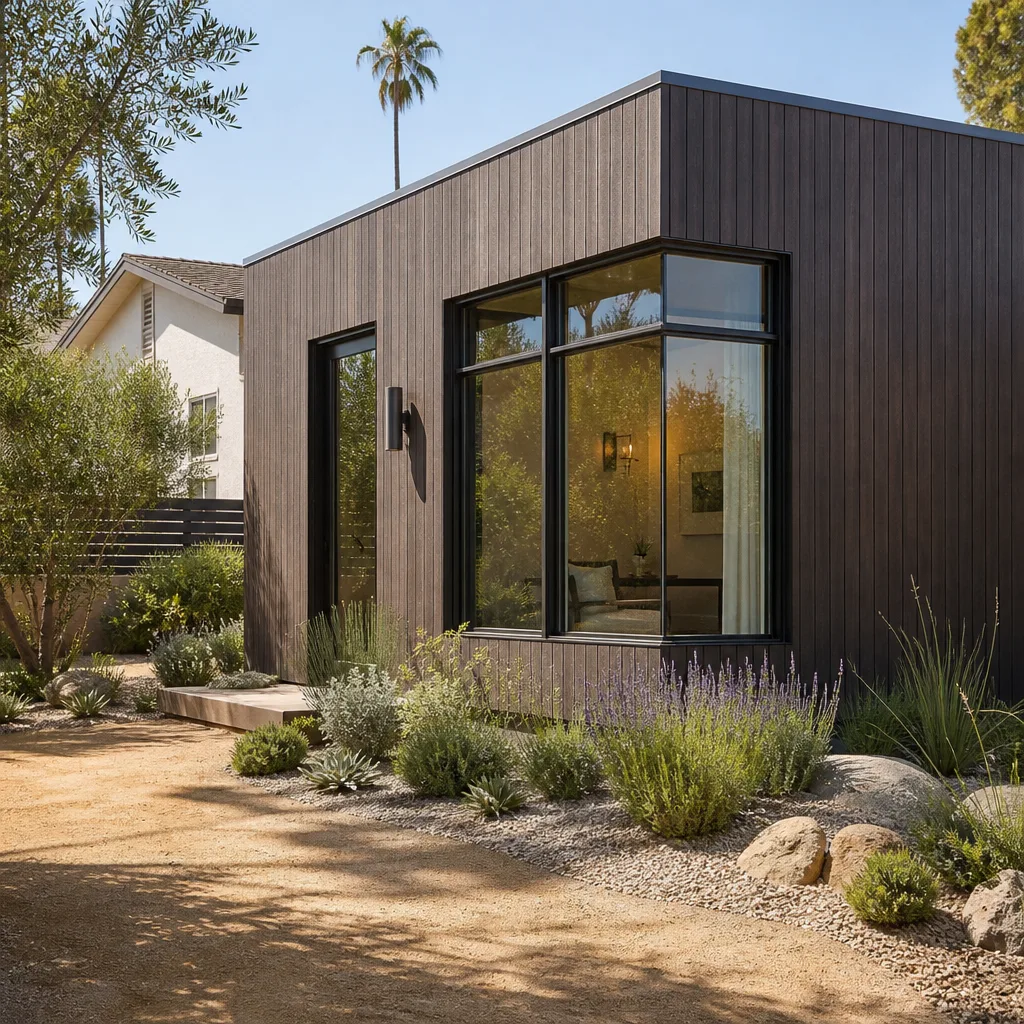
For a junior ADU (typically 150 to 400 square feet), partial James Hardie repair in Austin runs $2,500 to $7,000 depending on how much of the wall assembly we’re opening up. A full re-side with new trim and proper flashing for an existing junior ADU runs $9,000 to $18,000, and that’s before permit fees if the city requires one for the scope. The price difference comes down to what’s behind the siding. If the sheathing is sound, it’s a faster job. If we’re finding rotted framing, termite damage, or missing housewrap, the number changes, and you’ll know before we proceed, because the written price gets revised in writing, not spoken over the phone.
Every quote includes removal and disposal, flashing and sealant, fasteners matched to the substrate, primed James Hardie product, and paint on the replaced sections. We pull permits when Austin’s code requires it, which it often does once you’re touching exterior wall assemblies. The work is covered by our one-year written guarantee: if something fails inside that year, we come back and correct it at no charge. That’s the Garrison Standard, and it applies to every repair and conversion we do, not just the big builds.
DIY or Call Us?
There are things you can safely check yourself. Look at the clearance between the bottom edge of your siding and the ground or concrete. If it’s less than two inches, that’s a problem you can at least identify. Look at your trim joints, if they’re butted tight with no visible gap or caulk bead, water’s getting in. But actually replacing James Hardie boards, re-flashing, and repainting requires getting the reveal lines straight, the laps right, the fastener schedule correct, and the weather barrier continuous. Get one of those wrong and you’ve spent your weekend installing next year’s repair.
The bigger issue is safety on the structure itself. Junior ADU conversions often have the siding failing up near the roofline or around electrical penetrations. Working on a ladder with fiber cement boards, which are heavy and brittle, is how people get hurt. If the damaged section is above head height or anywhere near your electrical service, that’s a call to us at (361) 309-9568, not a Saturday project.
FAQs
James Hardie products carry a 30-year limited warranty, but in Austin’s climate with proper installation, you should expect 25 to 30 years before replacement. The failure we see at year eight or ten is almost always an installation issue, not a product issue. Call (361) 309-9568 and we’ll tell you which one you’re dealing with.
Yes, if the damage is localized and the surrounding boards are sound, we replace individual boards and trim pieces. The key is matching the profile and thickness, which we verify on site. Give us a call at (361) 309-9568 and we’ll take a look, the estimate is free.
A partial repair on a junior ADU is usually a one to two day job once we’re on site. A full re-side is three to five days. Weather in Austin can push that, and we’ll tell you if it does. Call (361) 309-9568 and we’ll give you a written schedule with the quote.
We keep the common profiles of HardiePlank and HardieTrim on our trucks, and we special-order non-stock colors and thicknesses with a few days’ lead time. We also work with Abodu, Cover, and Dvele prefab units, so if your junior ADU came from one of those manufacturers, we know the interface details already. Call (361) 309-9568 and we’ll confirm what we have available for your specific siding profile.
If you’ve got a James Hardie junior ADU conversion in Austin that’s showing its age, or you’re planning one and want the siding done right the first time, call (361) 309-9568. We’ll put the price in writing before any work starts, and we’ll stand behind it for a full year. Put it in writing, then do what it says.
Written by Reed Calloway, Owner, Fielding ADU Austin at Fielding ADU Austin, serving Austin and nearby areas.