Last updated October 15, 2026
How to Hire a ADU Contractor in Austin: A Step-by-Step Guide
A bid without a written scope of work is not a bid. It is a number a contractor can walk away from the moment conditions change, and in the Austin subcontractor market, conditions always change. You may already know this if you have been through a remodel that started with a handshake and ended with a change order. This guide gives you a process for hiring an ADU contractor in Austin that puts you in control before the first meeting, not after the first problem, and you can find more guides & resources on our blog. You will learn how to write a project brief, verify licenses, interview references, read contracts for the clauses that matter, and recognize a fixed written price for what it actually is: structural protection, not a perk.
Quick Answer
To hire an ADU contractor in Austin, start by writing a one-page project brief that defines the scope, then verify the contractor’s license and insurance through Texas TDLR and the Austin Development Services Department, interview past clients about schedule adherence and change-order behavior, and insist on a fixed written price before signing. The contractor who will not put the scope and price in writing before work starts is the contractor who will change both after it begins.
Table of Contents
- Write a One-Page Project Brief Before Contacting Any Contractor
- Verify License and Insurance: The Five Documents to Check
- Questions to Ask References That Actually Reveal Something
- How to Read a Contract for the Three Clauses That Shift Risk to You
- Why a Fixed Written Price Upfront Is Structural Protection
- How to Compare Bids So You Are Not Comparing Fiction to Fiction
- Austin Permitting, Code, and Timing: What the Process Actually Looks Like
- Common Mistakes to Avoid
- When to Call a Professional
- Frequently Asked Questions
- The Bottom Line
Write a One-Page Project Brief Before Contacting Any Contractor
Most Austin homeowners contact three contractors and describe the project differently to each one. One hears “a small apartment out back,” another hears “a studio with a kitchenette,” the third hears “we are still figuring it out.” Then three bids arrive covering three different scopes, and the homeowner compares the prices as if they described the same building. They did not.
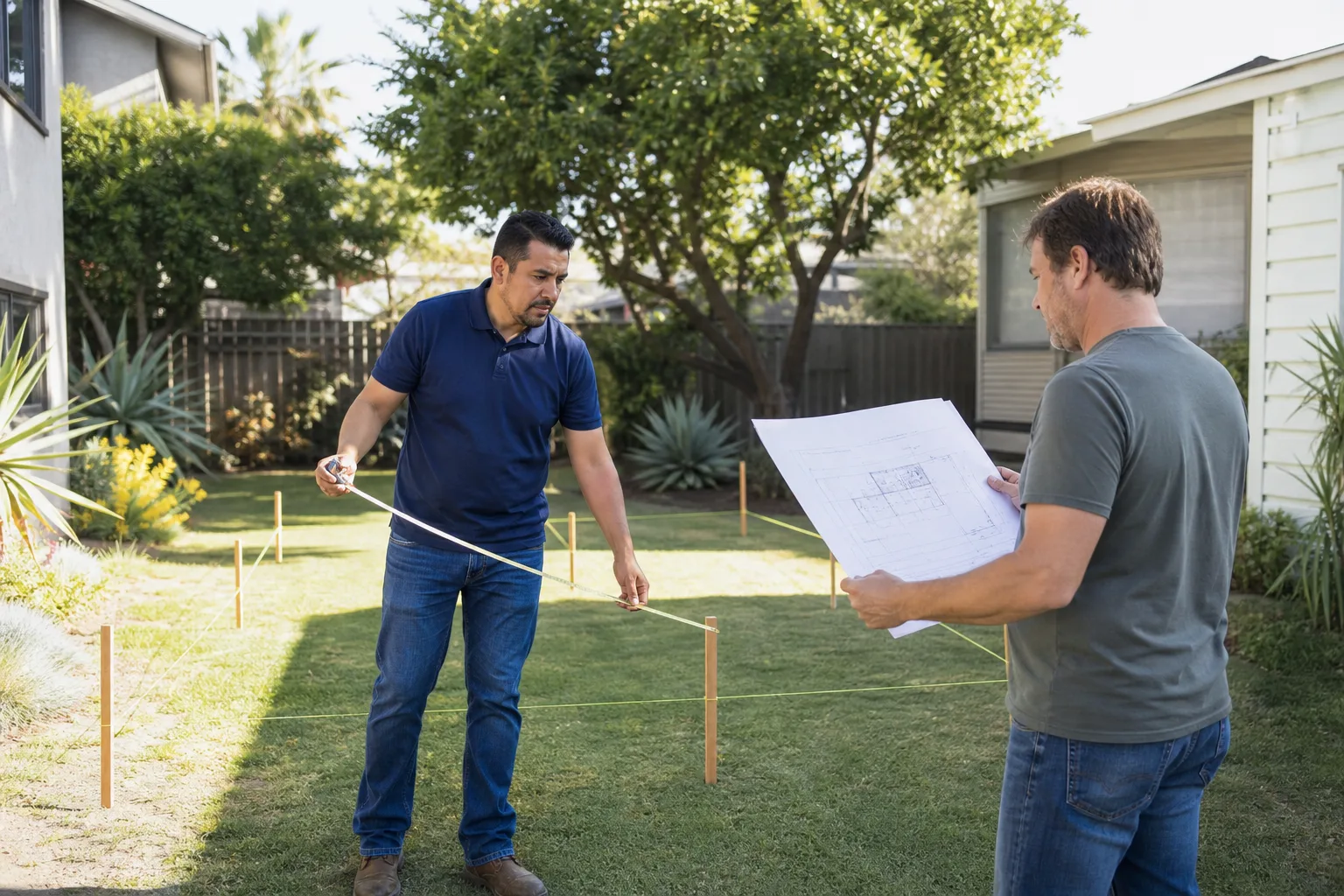
The fix is a one-page project brief. This is a document you write before the first phone call. It forces you to make decisions now, when changing your mind is free, rather than later, when changing your mind is a change order.
Your brief should include:
- Intended use: Who will live there? A parent, a tenant, a returning adult child, a home office. This drives plumbing, egress, and electrical decisions.
- Square footage target: A range is fine. “400 to 600 square feet” is specific enough to price, flexible enough to work with lot constraints.
- Room list: Bedroom count, bathroom count, kitchenette or full kitchen, laundry yes or no.
- Access and parking: Will the unit have its own entrance? Its own parking pad? This affects Austin site-plan review and utility connections.
- Build method preference: Conventional stick build, prefab panelized, or factory-built modular. Say if you are open or fixed. We work with all three, including Abodu, Cover, Dvele, and Mighty Buildings for modular, plus conventional framing with James Hardie siding.
- Budget ceiling: Your hard number. Not your hoping number. Writing it down keeps you from approving an over-budget design on day one.
- Timeline needs: Hard deadline or flexible. A lease ending, a baby arriving, a parent moving in. State it.
In our experience in Austin, the brief takes two hours to write and saves six weeks of bidding confusion. Every contractor gets the same document. Every bid covers the same scope. Comparison becomes possible.
One note on Austin specifically: your lot’s zoning district, impervious cover limits, and setback requirements will constrain what can be built regardless of what your brief says. A competent contractor will tell you this in the first conversation. Our ADU Builders in Austin page walks through the build methods and zoning considerations in more detail.
Verify License and Insurance: The Five Documents to Check
Texas does not require a state-issued general contractor license for residential work the way California or Florida does. That surprises a lot of Austin homeowners. What Texas does have is a patchwork of registration requirements, and what Austin has is a city permitting process that penalizes unpermitted work.
Here are the five things to verify through Texas TDLR and the Austin Development Services Department before a contractor sets foot on your property:
- TDLR registration where applicable: If the contractor holds any TDLR-issued trade license (electrical, plumbing, air conditioning), verify it at the TDLR license search portal. Not every general contractor holds these, but the subs who work under them should.
- Certificate of insurance naming you as additional insured: Ask for a certificate from the contractor’s insurer, and confirm it lists you as additional insured on the policy. This is standard practice. A contractor who resists this request is telling you something.
- Workers’ compensation coverage or a clear explanation of exemption: Texas allows some employers to opt out of workers’ comp. If the contractor has opted out, understand that an injured worker could look to your homeowner’s insurance. Ask directly.
- Austin DSD permit history: Search the Austin Build + Connect portal for the contractor’s name. You are looking for a pattern of permits pulled and finaled, not just pulled and left open. An open permit is a lien waiting to happen.
- References tied to the last 12 months: Not three references from 2019. You want projects completed recently, because the crew that built well five years ago is not necessarily the crew building today.
This is not bureaucracy for its own sake. An uninsured worker injured on your Austin property is a claim against your homeowner’s policy. An unpermitted ADU discovered at resale is a disclosure problem and a code compliance problem. The documents protect you before the first day of work, not after the last.
Questions to Ask References That Actually Reveal Something
“Were you happy with them?” is a useless question. Almost everyone who finished a project and is willing to take a reference call will say yes, they were happy. The useful questions are specific and behavioral.
Here is a numbered script. Steal it.
- “Did the project finish on the date the contractor originally promised? If not, how far off was it, and when did you learn about the delay?” This reveals schedule honesty. A contractor who tells you about a delay the day it becomes known is honest. A contractor who lets you discover the delay yourself is not.
- “How many change orders did you sign, and for what total dollar amount?” Now you know the real price of the project, not the bid price. If the original bid was $150,000 and the change orders totaled $40,000, that is not a $150,000 contractor. That is a $190,000 contractor who bid low.
- “Did the contractor manage the permits, or did you have to chase them?” Permit management is the single most common failure point in Austin ADU projects. A contractor who hands the permit responsibility back to the homeowner has offloaded the hardest part of the job.
- “Who was on your site every day? Was it the same crew, or a rotating cast?” This reveals whether the contractor self-performs the work or subcontracted the whole thing to whoever was available in the Austin labor market that week.
- “What is one thing about the project you wish you had known before you started?” This question gets the truth faster than any direct inquiry. People who have been through it once will tell you exactly what they would do differently.
Three references, five questions each, fifteen minutes per call. That is forty-five minutes of due diligence that can save you a year of regret.
How to Read a Contract for the Three Clauses That Shift Risk to You
Most people read the price and the start date, then sign. The risk is not in the price line. The risk is buried in three clause types that appear in nearly every construction contract, and each one shifts financial risk from the contractor to you.
First: allowances. An allowance is a placeholder number for materials not yet selected, and it is the most common way a bid price inflates after signing. A contract might say “flooring allowance: $4,000.” Then you select flooring that costs $6,500 installed, and the difference – plus the contractor’s markup – lands on your final invoice. There is nothing wrong with allowances in principle. The problem is when they are vague, undersized, or used for major systems. A contract with eleven allowances is not a fixed price. It is a menu of future change orders. Ask for allowances to be realistic and itemized, and ask which ones the contractor expects to be exceeded. If they will not tell you, they are hiding the real price.
Second: exclusions. Exclusions are what the contractor has carved out of the scope, and they are often listed on page six in dense language. Utilities connections, site grading, tree removal, Austin DSD inspection fees, erosion controls, even dumpster rental. Each exclusion is a cost you will pay separately, to someone else. Read the exclusions list and cost each item before you sign. If the exclusions section is empty, the scope is full.
Third: dispute resolution language. If the contract requires binding arbitration in a venue far from Austin, or waives your right to a mechanic’s lien defense, or says disputes will be resolved “per industry custom,” read again. Those clauses decide what happens when something goes wrong, and they are written by the contractor’s attorney for the contractor’s benefit. You are allowed to strike them or negotiate them. If the contractor refuses, consider what that tells you about who holds the power in the relationship.
We put our price in writing before any work starts, and our contracts state the scope, the exclusions, and the guarantee terms in plain language. If you want to see how a Garage Conversion Contractor in Austin handles this differently, the page shows what a written-price commitment looks like in practice.
Why a Fixed Written Price Upfront Is Structural Protection
A fixed written price is not a customer-service perk. It is a structural protection that changes the financial incentives of the entire project.
When a contractor works on time and materials, or on a cost-plus contract, every additional day of labor and every additional material purchase flows through to your invoice. The contractor bears the upside of overruns. You bear the cost. That is not a moral failing on the contractor’s part. It is just how incentives work under that contract structure.
When the price is fixed in writing before work begins, the incentive flips. The contractor now bears the cost of inefficiency, rework, and scheduling failures. When a sub cancels and the contractor has to pay overtime to keep the schedule, that comes out of the contractor’s margin, not your checkbook. A written price is the single strongest signal that the contractor intends to manage the project rather than just bill the project.
And here is the part most guides skip: a written price also protects you from the Austin market. Material prices for lumber, concrete, and engineered wood move through the year. Subcontractor rates fluctuate with the volume of new construction across Travis County. A contractor who will not commit to a written price is reserving the right to pass every market fluctuation through to you in real time. That is not a partnership. That is a hedge fund with your checkbook as the collateral.
Walk away from contractors who refuse to provide a fixed written price. You are not walking away from a good deal. You are walking away from an open-ended liability wearing a bid’s clothing.
How to Compare Bids So You Are Not Comparing Fiction to Fiction
You have three bids. They are for different scopes, different allowances, different exclusions, and different build methods. Comparing the bottom-line numbers is meaningless until you normalize the bids.
Here is the normalization process we recommend to Austin homeowners:
- Build a line-item comparison table. Each row is a scope item: foundation, framing, roofing, siding, electrical rough-in, plumbing rough-in, insulation, drywall, finishes, permits, site work. Each column is a contractor. Fill in the numbers from each bid. The gaps tell you more than the totals.
- Flag every line where one bid is blank or “included in other.” That is either a hidden cost or a line the bidder forgot. Ask directly.
- Compare the allowance amounts, not just the allowance line items. A $4,000 flooring allowance and an $11,000 flooring allowance are not the same bid. One contractor is pricing the floor you said you wanted. The other is pricing the floor you will probably settle for after you see the change order.
- Compare the warranty or guarantee language. “One-year workmanship warranty” and “we will return and correct any defect for 365 days at no charge” are not the same promise. One is a phrase. The other is a commitment.
- Compare the payment schedule. A contractor asking for 50% before breaking ground is financing the project with your money. Standard is a deposit plus draws tied to completed milestones. If the draw schedule is loaded forward, ask why.
Every ADU we build in Austin follows The Garrison Code: show up in the window, price in writing, by the book, leave it clean, stand behind it for a year. The 365-Day Done Right Promise is a written guarantee covering workmanship defects for a full year. If it is not done right, we come back and make it right at no charge. That is the Fielding ADU Austin home standard, and it is the same standard Garrison Partners has held its members to since 2006.
Austin Permitting, Code, and Timing: What the Process Actually Looks Like
An ADU in Austin is not a backyard shed. The city treats an accessory dwelling unit as a residential structure subject to the full permitting process through the Austin Development Services Department, and the process has real timelines. For ongoing upkeep after construction, see our Seasonal ADU Care for Austin: Year-Round Homeowner’s Guide.
Here is what to expect, in order:
- Site plan review: Austin requires a site plan or a site plan exemption for most ADU projects. This reviews setbacks, impervious cover, tree preservation, and utility easements. Expect this to take anywhere from two to eight weeks depending on complexity and DSD workload.
- Building permit: Submitted after site plan approval. The plans must meet the current adopted building codes, which Austin updates on a cycle. A contractor who has not permitted an ADU in Austin recently may be surprised by current requirements.
- Trade permits: Electrical, plumbing, and mechanical permits are pulled separately. These require licensed tradespeople whose licenses are current with TDLR.
- Inspections: Foundation, rough-in for each trade, insulation, drywall, and final. Each inspection is scheduled through Austin Build + Connect. A missed inspection can add a week to the schedule.
- Certificate of occupancy: For an ADU with a kitchen or full bath, Austin requires a final inspection and certificate before anyone moves in.
Total time from contract signing to move-in in Austin typically runs five to ten months for a conventional build, and sometimes less for factory-built modular units from companies like Abodu, Cover, or Dvele, whose production happens off-site while your foundation is being prepared. The prefab route can compress the on-site work substantially, though the permit timeline is the same either way.
One question we get often from Austin homeowners: can I skip the permits? The answer is that unpermitted ADUs get discovered at resale, during insurance claims, and when neighbors file code complaints. The Austin Code Department investigates complaints, and the fix for an unpermitted unit is more expensive than the permit would have been. Pull the permits. It is not optional, and any contractor who suggests otherwise is not acting in your interest.
Common Mistakes to Avoid
- Comparing bids with different scopes. If one bid includes utility trenching and another excludes it, the bottom-line numbers mean nothing. Normalize before comparing. See the comparison section above.
- Signing a contract with vague allowances. “Allowance: $5,000 for kitchen” is not a number. It is an invitation to a change order. Get allowances itemized and realistic before signing.
- Paying too much upfront. A contractor asking for half the project cost before demolition starts is using your money as working capital. Draws tied to completed milestones are industry standard.
- Skipping the reference calls. Forty-five minutes of phone calls is the cheapest due diligence available. Skip it and you are purchasing a six-figure product unseen.
- Ignoring the exclusions list. Read every line. Cost the exclusions separately. If the exclusions total $25,000, the real price of the project is the bid plus $25,000.
- Choosing a contractor based on availability. In the Austin market, a contractor who can start next week is often available for a reason. The one with a two-month backlog is usually booked because they finish projects on schedule.
- Accepting an open-ended price. “Cost plus 10%” means every overrun adds to your invoice and the contractor’s fee. A fixed written price flips that incentive in your favor.
When to Call a Professional
This guide exists so you can self-qualify before calling anyone. But there are points where the right move is a phone call, not another hour of research. If you have a written project brief and cannot get three contractors to bid the same scope, call a specialist. If you have doubts about your lot’s zoning or whether an ADU is even allowed on your property, call someone who works in Austin permitting regularly. If you have been burned before and want to see a written price and a written guarantee before you commit, call us. Fielding ADU Austin offers free estimates in Austin – call (361) 309-9568 and a live person will answer, any hour, any day.
Frequently Asked Questions
ADU construction in Austin typically runs $250 to $450 per square foot for a conventional build, meaning a 600-square-foot unit lands between $150,000 and $270,000 before permit fees and site work. For a detailed look at where every dollar goes, see our ADU Cost Breakdown: The Austin Homeowner’s Reference for 2026. Prefab and modular options from companies like Abodu and Cover usually fall in a similar range but compress the on-site timeline. Garage conversions run lower because the structure already exists. Call (361) 309-9568 for a written, line-item estimate on your specific project – the estimate is free.
Yes, an ADU in Austin requires a building permit through the Austin Development Services Department, and most projects also require trade permits and site plan review. Unpermitted ADUs create liability at resale and code enforcement risk. Any contractor who suggests skipping permits is not looking out for you.
Yes, and the prefab route works well in Austin. Companies like Abodu, Cover, and Dvele build the unit in a factory while the site is prepared on your property, which shortens the construction timeline on your lot. Fielding ADU Austin works with all three platforms and handles the foundation, utility connections, and Austin permitting for you. Ask us which build method fits your lot and budget.
A written contract should include a fixed price, an itemized scope of work, a realistic allowance schedule, a written exclusions list, a payment schedule tied to milestones, and written warranty or guarantee terms. Read the dispute resolution language before signing. If the contract is missing any of these, it is not complete.
Plan on five to ten months from contract signing to move-in for a conventional build in Austin, including permitting. Prefab or modular units can shorten the on-site portion significantly, but the Austin permit timeline applies either way. Ask us for a realistic schedule based on your specific lot and scope – we will put it in writing.
Some do, and the terms vary widely. For a framework of what to expect, see our Room Addition Contractor Maintenance Checklist for Austin Homeowners. Fielding ADU Austin backs every ADU with a written 365-Day Done Right Promise: if workmanship fails within one year, we return and correct the defect at no charge. Garrett Partners has held its members to this standard since 2006. Ask any contractor you are considering to put their warranty terms in writing before you sign.
The Bottom Line
Hiring an ADU contractor in Austin the right way means doing the work before the work starts. Write the brief. Verify the license and insurance. Call the references and ask the questions that reveal schedule honesty and change-order behavior. Read the contract for allowances, exclusions, and dispute clauses. Compare bids only after normalizing them. And insist on a fixed written price, because a contractor who will not commit to a price in writing is a contractor who intends to change it later. The contractors worth hiring are the ones who welcome this process, not the ones who resist it. If you want to go deeper, our Room Addition Contractor in Austin page covers the same standard applied to attached additions.
Written by Reed Calloway, Owner at Fielding ADU Austin, serving Austin since 2006.